
If your organization uses Microsoft 365, you’ve probably come across something called Microsoft Secure Score. It sits inside the Microsoft security ecosystem and provides a numerical representation of your organization’s security posture.
For many business leaders and IT teams, seeing a score can be both reassuring and concerning. A high score feels like you’re doing something right. A low score raises questions about vulnerabilities, compliance, and risk.
But what exactly is Microsoft Secure Score measuring?
More importantly, what is it actually telling you about your business?
The answer is more nuanced than many organizations realize. While Secure Score can be a valuable security benchmark, it should never be viewed as a simple pass-or-fail grade. Instead, it serves as a roadmap for identifying security gaps, prioritizing improvements, and strengthening your overall cybersecurity strategy.
In this guide, we’ll break down what Microsoft Secure Score is, how it works, what the numbers mean, and how organizations can use it to make smarter security decisions.

Unsure where your biggest cyber risks are?
PCA helps internal IT teams and growing organizations make the right technology decisions.
What Is Microsoft Secure Score?
Microsoft Secure Score is a security analytics tool built into Microsoft 365 that evaluates your organization’s security settings, configurations, and behaviors.
The platform assigns points based on security actions that have been implemented across your Microsoft environment, including:
- Microsoft 365
- Azure Active Directory (Microsoft Entra ID)
- Microsoft Defender
- Exchange Online
- SharePoint
- Teams
- Endpoint security controls
The score is designed to help organizations:
- Understand their current security posture
- Identify potential risks
- Prioritize security improvements
- Compare against industry benchmarks
- Track progress over time
Think of it as a cybersecurity health check for your Microsoft environment.
How does Microsoft Secure Score Work?
Microsoft Secure Score evaluates hundreds of security-related controls and assigns points when recommended protections are implemented.
For example, you may receive points for:
- Enabling multi-factor authentication (MFA)
- Requiring strong password policies
- Protecting administrator accounts
- Implementing conditional access policies
- Securing endpoints with Microsoft Defender
- Configuring email protection features
- Restricting risky user behavior
Each action carries a different point of value based on its impact on security.
The higher your score, the more recommended security controls you’ve adopted.
However, a perfect score is not necessarily the goal.
Microsoft intentionally designs Secure Score as a continuous improvement framework rather than a checklist that reaches 100% completion.
What Is Considered a Good Microsoft Secure Score?
One of the most common questions organizations ask is:
“What is a good Microsoft Secure Score?”
The reality is that there is no universal target.
A good score depends on factors such as:
- Company size
- Industry Regulatory requirements
- Risk tolerance
- Technology stack
- Business operations
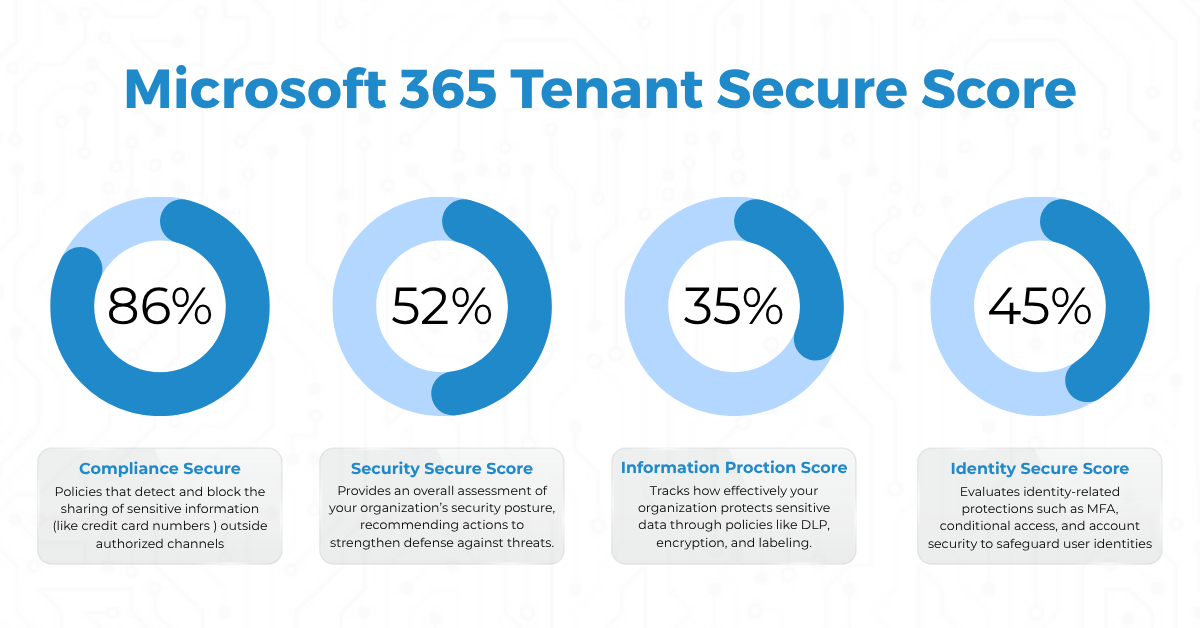
Microsoft also provides comparison data that allows you to benchmark your score against organizations with similar characteristics.
Rather than obsessing over the number itself, focus on whether your score is trending upward and whether high-impact recommendations are being addressed.
What Your Secure Score Is Actually Telling You
Many organizations misunderstand Secure Score because they focus solely on the number.
The real value lies in what the score reveals.
1. It Shows Where Risk Exists
A low Secure Score often highlights areas where attackers may have an easier path into your environment.
Examples include:
- No MFA enabled
- Weak administrator protections
- Inadequate email security
- Missing endpoint protections
- Poor device management
Even recommendations represent a potential opportunity to reduce risk.
The score essentially points out where your cybersecurity posture can be strengthened.
2. It Highlights Security Priorities
Most businesses don’t have unlimited time or resources.
Secure Score helps prioritize improvements based on impact.
Instead of guessing where to start, organizations can focus on controls that provide the greatest security benefit.
This allows IT teams to make measurable progress without becoming overwhelmed by hundreds of potential security initiatives.
3. It Reveals Configuration Gaps
Many organizations invest heavily in Microsoft licensing but fail to fully utilize the security tools they already own.
Secure Score often uncovers:
- Unused security features
- Misconfigured policies
- Incomplete deployments
- Underutilized Microsoft Defender capabilities
In some cases, businesses discover they’re already paying for security tools that could significantly improve protection if configured correctly.
4. It Helps Measure Improvement Over Time
Cybersecurity isn’t a one-time project.
Threats evolve constantly.
Secure Score provides a way to track progress and demonstrate improvement month after month.
This can be especially valuable for:
- Executive reporting
- Board presentations
- Compliance initiatives
- Cyber insurance discussions
- Security audits
The ability to show measurable security improvements often helps justify technology investments.
What Secure Score Does NOT Tell You
While Secure Score is useful, it has limitations.
Understanding these limitations is critical.
It Doesn’t Guarantee Security
A high score does not mean you’re immune to cyberattacks.
Organizations with an excellent score can still experience:
- Phishing attacks
- Ransomware incidents
- Insider threats
- Credential Theft
- Social engineering attacks
- Security is about risk reduction, not risk elimination.
It Doesn’t Measure User Behavior
Employees remain one of the largest cybersecurity risks.
Secure Score evaluates configurations, but it doesn’t fully account for:
- Poor security awareness
- Unsafe browsing habits
- Credential sharing
- Human error
This is why security awareness training remains essential
It Doesn’t Replace Security Monitoring
You can have a strong Secure Score and still miss active threats.
Organizations also need:
- Threat detection
- Security monitoring
- Incident response
- Log analysis
- Endpoint monitoring
This is where managed cybersecurity services often play a critical role.
Why Many Businesses Struggle to Improve Their Score
Improving Secure Score sounds simple in theory.
In practice, many organizations face challenges such as:
Limited Internal Resources
Small and mid-sized businesses often have lean IT teams.
Daily operational tasks leave little time for security optimization.
Lack of Security Expertise
Some recommendations require advanced knowledge of:
- Microsoft Entra ID
- Conditional Access
- Microsoft Defender
- Exchange security
- Endpoint management
- Without specialized expertise, organizations may delay important improvements.
Fear of Disrupting Users
Security changes can affect workflows.
Businesses sometimes avoid implementing protections because they worry about user resistance.
Examples include:
- MFA requirements
- Device restrictions
- Access controls
- Password policies
The key is balancing security with productivity.
In need of specific IT Solution?
Our Co-managed IT offers a collaborative approach, combining your internal IT team’s knowledge with the specialized skills and resources available through PCA Technology Solutions.
How Managed IT Service Can Help Improve Secure Score
Many organizations view Secure Score as an IT responsibility.
In reality, improving security posture often requires a strategic approach that combines technology, policy, and ongoing management.
This is where a Managed IT Services provider can deliver significant value.
An experienced Managed IT partner can:
- Assess current security posture
- Review Secure Score recommendations
- Prioritize high-impact improvements
- Configure Microsoft security tools properly
- Monitor ongoing changes
- Maintain compliance requirements
- Align Security controls with business objectives
Instead of chasing points, businesses can focus on implementing meaningful security improvements that reduce real-world risk.
A strong Managed IT strategy ensures Secure Score becomes part of a broader cybersecurity roadmap rather than just another dashboard metric.
Practical Ways to Improve Your Microsoft Secure Score
If you’re looking for immediate improvements, consider these high-impact actions:
Enable Multi-Factor Authentication
MFA remains one of the most effective security controls available.
It significantly reduces the risk of compromised credentials, leading to unauthorized access.
Protect Administrative Accounts
Administrative accounts should have:
- Dedicated admin credentials
- Strong MFA
- Conditional Access policies
- Limited Privileges
Administrative accounts are among the most targeted assets in any environment.
Review Conditional Access Policies
Conditional Access helps control:
- Who can access resources
- From where
- On what devices
- Under what conditions
These policies create important layers of protection.
Strengthen Email Security
Email remains the primary attack vector for cybercriminals.
Organizations should implement:
- Anti-phishing policies
- Safe Links
- Safe Attachments
Secure Endpoints
Every laptop, desktop, and mobile device represents a potential entry point.
Modern endpoint protection should include:
- Threat detection
- Device compliance monitoring
- Vulnerability management
- Automated remediation
Looking Beyond the Score
The most successful organizations don’t treat Secure Score as a competition.
They treat it as a decision-making tool.
A score is only valuable when it leads to action.
The goal isn’t achieving a perfect number. The goal is reducing risk, improving resilience, and ensuring your technology environment supports business growth securely.
Organizations that consistently review their Secure Score, implement meaningful recommendations, and align security improvements with broader business objectives often see the greatest long-term benefits.
So Now What?
Microsoft Secure Score provides valuable insight into the security health of your Microsoft environment. It highlights strengths, uncovers weaknesses, and helps prioritize security improvements that can reduce risk.
However, the score itself is only part of the story.
A strong cybersecurity posture requires more than configuration settings. It requires ongoing monitoring, strategic planning, user education, and continuous improvement.
Rather than asking, “Is our score high enough?” a better question is:
“What is our Secure Score telling us about the risks we still need to address?”
When organizations approach Secure Score this way, it becomes a powerful tool for building a stronger and more resilient security program.
Ready to Improve Your Microsoft Secure Score?
Many organizations know they should improve their Microsoft Secure Score but aren’t sure where to begin, or which recommendations will have the greatest impact. That’s where expert guidance can make all the difference.
PCA Technology Solutions is a Managed Security Services Provider (MSSP) and Managed IT Services company with more than 30 years of experience helping organizations leverage technology securely and strategically. Recognized among the world’s Top 250 MSSPs, PCA serves businesses throughout Arkansas, Dallas, and surrounding regions with cybersecurity, managed IT services, co-managed IT, Microsoft 365 solutions, VoIP communications, and IT coaching. PCA specializes in supporting healthcare, manufacturing, transportation, legal, financial, and professional service organizations through proactive technology management, security best practices, and strategic IT planning. By combining technical expertise with a coaching-first approach, PCA helps businesses improve productivity, strengthen cybersecurity, reduce downtime, and align technology investments with long-term business goals.
Whether you need help optimizing Microsoft 365 security settings, improving your Secure Score, or building a proactive cybersecurity strategy, PCA can help you turn security insights into meaningful business protection.
Contact PCA Technology Solutions today to learn how a strategic Managed IT and cybersecurity partnership can strengthen your organization’s defenses.

Sean Tappe
Executive VP of Operations | PCA Technology Solutions
Sean Tappe is the Executive Vice President of Operations at PCA Technology Solutions, a role he has held with distinction. Sean’s journey with PCA began in 2008 as a Network Engineer. Through his dedication, expertise, and commitment to excellence, he quickly rose through the ranks within the organization. In his current role as Executive Vice President of Operations, Sean brings a unique blend of technical prowess, strategic vision, and a deep-rooted passion for exceptional customer service. He is known for his meticulous attention to detail, thoughtful approach to problem-solving, and deliberate decision-making process. Sean’s leadership style is characterized by a steadfast commitment to thorough research, enabling him to make informed and impactful decisions that drive PCA’s continued success.
Outside of his professional pursuits, Sean is an avid advocate for community engagement and giving back. Sean enjoys time with his wife and four children, spending time with friends, leading worship at church, and playing various sports and games. Living by the personal motto, “Here to serve,” Sean actively volunteers his time and expertise to various charitable initiatives, reflecting his commitment to making a positive impact beyond the realm of technology.

Effective 2026 Tech Budgeting for SMBs: A Step-by-Step Guide
If you’re running a small or medium business (SMB), gearing up for 2026 means more than just buying the latest device or signing another subscription. It’s about strategic tech budgeting, making sure every dollar of your tech spend supports your business goals. In...

Unmasking Cyber Threats: From Simple Viruses to Smart AI
Cybersecurity has always been a game of cat and mouse. As technology advances, so do the threats that exploit it. From the first computer viruses that spread through floppy disks to today’s sophisticated AI-powered cyber-attacks, the evolution of cyber threats has...

Cyber Hygiene 101: Defend Your Digital Life Now
In today’s digital-first world, our devices are an extension of ourselves. From mobile banking to shopping online, streaming, social media, and remote work, we spend most of our lives online. Just as we brush our teeth and wash our hands to prevent illness, we also...