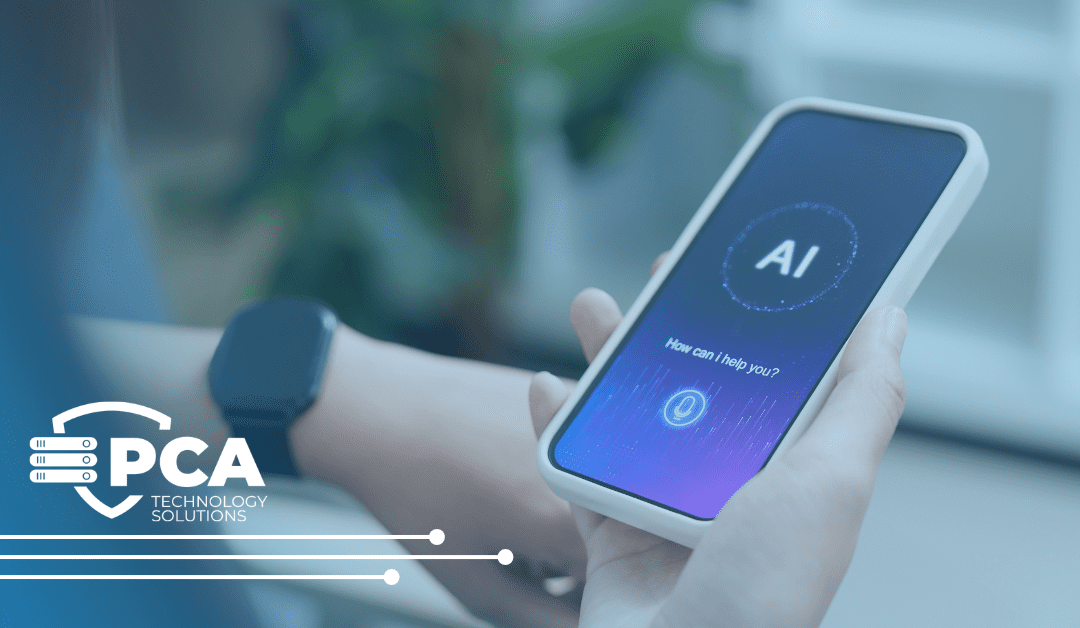
Businesses’ perspectives on communication are being drastically transformed by artificial intelligence today. And one of the most talked-about breakthroughs is the AI receptionist, a system designed to answer calls, respond to customer inquiries, and support front desk operations without the need for human intervention.
This is a big step for business leaders. Compelling advantages include quicker response times, fewer missed calls, and round-the-clock accessibility. AI is certainly going to play a role in business communications in the future, but it shouldn’t be implemented without the right preparation, structure, and a strong foundation.
As a Managed Security Services Provider, PCA is actively preparing the application of AI and evaluating how it will integrate into our communication services. We continue to focus on offering VoIP solutions that are incredibly stable, secure, and completely functioning, even though our current service portfolio does not yet contain AI receptionist skills. In general, we provide the fundamental communication functions that most businesses nowadays desire.
In the meantime, we are keeping a careful eye on developments from our technology partners to make sure that when we do implement AI-driven capabilities, they will be useful, safe, and prepared for actual business environments.

Strengthen Your Communications Today!
Partner with PCA Technology Solutions for reliable, cost-effective VoIP solutions that keep your team connected and productive
Why AI Receptionists Are Creating So Much Interest
Missed or delayed client communication is a typical corporate concern that AI receptionists directly solve, which is why they are earning attention nowadays.
Calls are still the main method used by many businesses to interact with customers. When those calls go unanswered or are placed on hold too long, opportunities are lost.
The main goal of AI receptionists is to address this by offering automated call processing that can:
- Respond to incoming calls right away.
- Give callers basic information.
- Direct calls to the appropriate department
- Assist in setting up appointments.
- Gather client information and leads.
This gives the impression that the front desk is completely automated and never sleeps. For many businesses, especially those with high call volume, this is extremely appealing.
Though the idea is reliable, execution has not yet been established.
The Reality Behind AI in Business Communication
Despite the excitement, AI receptionist solutions are not yet universally plug-and-play. When trying to adopt them without enough planning, many businesses run into difficulties.
AI works best when it operates within a structured environment. Strong system integrations, clear workflows, and clean data are necessary. Performance may become erratic in the absence of these.
Cost predictability is another factor to take into account. Usage-based pricing models, which are used by many AI-driven communication solutions, can be challenging to predict as business demand increases.
Security and compliance are other significant factors to take into account. In industries where data protection is crucial, voice data, customer interactions, and company information must all be managed responsibly.
This is why many organizations are taking a measured approach rather than rushing into full AI adoption.
Why VoIP Remains the Strongest Foundation for Business Communication
VoIP is still the most dependable and extensively used communication platform for companies of all sizes, even though AI is developing.
Modern VoIP systems are not just phone systems. They are comprehensive platforms for communication created to facilitate daily company activities.
They provide stability, scalability, and flexibility that businesses can depend on.
Most importantly, VoIP systems nowadays come with a lot of functions that companies require without the need for extra complexity or experimental tools.
These include:
- Intelligent call routing and queue management
- Call recording, transcription, and voicemail
- Video conferencing and team messaging
- Integration of business applications and CRM
- Accessibility across several devices for remote and hybrid teams
These features are tested, extensively used, and available for use in small, medium, and large-scale settings.
Additionally, VoIP offers predictable cost structures, which facilitate business expansion without unforeseen costs.
How AI Will Enhance VoIP, Not Replace It
The future of business communication is not AI replacing VoIP. VoIP systems are being overlaid with AI to improve efficiency and performance.
Early iterations of this progression are already available in the market. In communication platforms, AI is starting to help with call handling, transcription, and workflow automation.
Some emerging capabilities include:
- AI-assisted call routing that helps direct callers more accurately based on intent
- Automated call summaries that help teams quickly understand conversations.
- Real-time transcription that improves documentation and follow-up processes
- Simple AI assistants capable of responding to standard consumer questions
These features are promising, but they are still maturing. In most cases, they work best when paired with a strong VoIP foundation rather than standalone systems.
In need of specific IT Solution?
Our Co-managed IT offers a collaborative approach, combining your internal IT team’s knowledge with the specialized skills and resources available through PCA Technology Solutions.
What Our Current Approach Means for Customers
At this stage, we are not offering standalone AI receptionist solutions. Rather, we are concentrating on improving and fortifying the VoIP platforms that are already accessible via our vendor network.
The solutions we support today are designed to be:
- Easy to deploy across business sizes
- Fully functional without additional complexity
- Scalable as organizations grow
- Secure and compliant for business communication needs
- Rich in features that already support customer engagement
Without depending on experimental AI layers that could add complexity or unpredictability, these solutions offer everything organizations need to manage communication successfully now.
We are actively getting ready for the next phase of evolution at the same time. We are testing real-world use cases, assessing AI capabilities as they develop, and making sure that when we implement AI features, they will be completely in line with operational stability and commercial requirements.
The Direction of AI in VoIP: What Businesses Should Expect
AI in communication systems is starting to take shape. Businesses should anticipate a deeper integration of AI into VoIP platforms over the next few years.
Important advancements consist of:
- More sophisticated automation that manages standard communication duties
- Better communication between corporate apps and AI tools
- Improved possibilities for on-premises processing and data privacy controls
- More intelligent, knowledge-based assistants that have been educated using data unique to the firm.
- More stable pricing structures that facilitate the expansion of businesses
AI will become increasingly useful for regular business applications due to these developments. But it will take some time for them to develop completely reliable, business-ready solutions.
Why a Hybrid Strategy Is the Smartest Move Today
The best approach is not to replace AI right away. It is a structured transition strategy.
VoIP should continue to be the primary means of communication since it is reliable, safe, and capable of meeting modern corporate demands.
AI should be seen as an improvement that will be added progressively as it improves dependability and integration.
This strategy lowers risk, guarantees continuity, and enables companies to implement innovation without interfering with daily operations.
Additionally, instead of rushing into early-stage implementations, it guarantees that enterprises are prepared for AI when technology reaches full maturity.
Key Considerations for Decision Makers
When evaluating communication strategies that involve AI and VoIP, business leaders should focus on practical outcomes rather than trends.
Important questions to consider include:
- How well does the system operate with current tools and workflows?
- If the answer can grow without getting more complicated
- How predictable and controllable are the long-term expenses?
- Does the platform adhere to security and compliance standards?
- How the system functions in the event that AI components malfunction or are unavailable
These factors aid in guaranteeing that every investment promotes sustained operational performance.
Our Commitment Moving Forward
AI receptionists represent an exciting shift in how businesses will manage communication in the future. However, today’s reality is that VoIP remains the most practical, stable, and scalable solution for organizations of all sizes.
The most successful businesses will not rush into AI adoption. They will build strong VoIP foundations and introduce AI thoughtfully as the technology matures.
This balanced approach ensures that businesses gain the benefits of innovation without sacrificing reliability or control.
Talk to Us About Smarter Communication Solutions
If you are exploring how to improve your business communication strategy, now is the right time to take a structured and forward-looking approach.
We can help you:
- Review your current VoIP environment.
- Identify practical improvements using existing platform capabilities.
- Understand where AI will realistically add value in the future.
- Build a communication roadmap that is secure, scalable, and future-ready
While AI capabilities are not yet part of our current offering, we are committed to guiding businesses toward the most effective and reliable solutions available today, while preparing for what comes next.
Connect with us to start building a smarter communication strategy that works now and evolves with you.

Tony Fry
Director of Innovative Solutions
Tony Fry is the Director of Innovative Solutions at PCA Technology Solutions, where he has been a dedicated employee since 1998. With over two decades of experience in the industry, Tony specializes in the strategic review and seamless implementation of cutting-edge IT solutions. His expertise lies in identifying innovative technologies and translating them into practical applications that drive efficiency and growth for businesses. Tony’s forward-thinking approach and deep understanding of IT infrastructure make him an invaluable asset in navigating the ever-evolving landscape of technology. Passionate about leveraging technology to solve complex challenges, Tony is committed to driving impactful and transformative solutions for PCA Technology Solutions and its clients.

The New Era of AI in Law: What Really Works
AI is transforming legal work. A recent case involving an Arkansas attorney using AI highlights that the real question for law firms is not whether to use AI, but how and when to do so. A strong AI strategy does not replace legal skills with automation. Instead, it...

5 Simple Cybersecurity Tips Every Healthcare Leaders Should Know
Healthcare leaders often don’t focus on cybersecurity when things are running smoothly. Staff stay busy with patient care, systems work as expected, and appointments go as planned. But a cyberattack can quickly disrupt everything. Sensitive data may...

Cyber Resilience: A Smart Move for Business Growth
In a digital era defined by rapid innovation and interconnected systems, cyber threats have become persistent and sophisticated. From ransomware attacks on corporations to data breaches that compromise millions of customer records, modern cyber risks are not a...